DevOps & Automation
CI/CD, GitOps, Infrastructure as Code, and automation to ship faster and safer.
System online · Kathmandu, Nepal
Building reliable systems that scale. Managing complex infrastructure with code-driven precision.
I'm Sulav Adhikari, a DevOps Engineer and Software Engineer at Webpoint Solutions in Kathmandu, Nepal. I build reliable cloud infrastructure, Kubernetes platforms, backend services, and PostgreSQL systems using AWS, GitOps, Go, and automation.
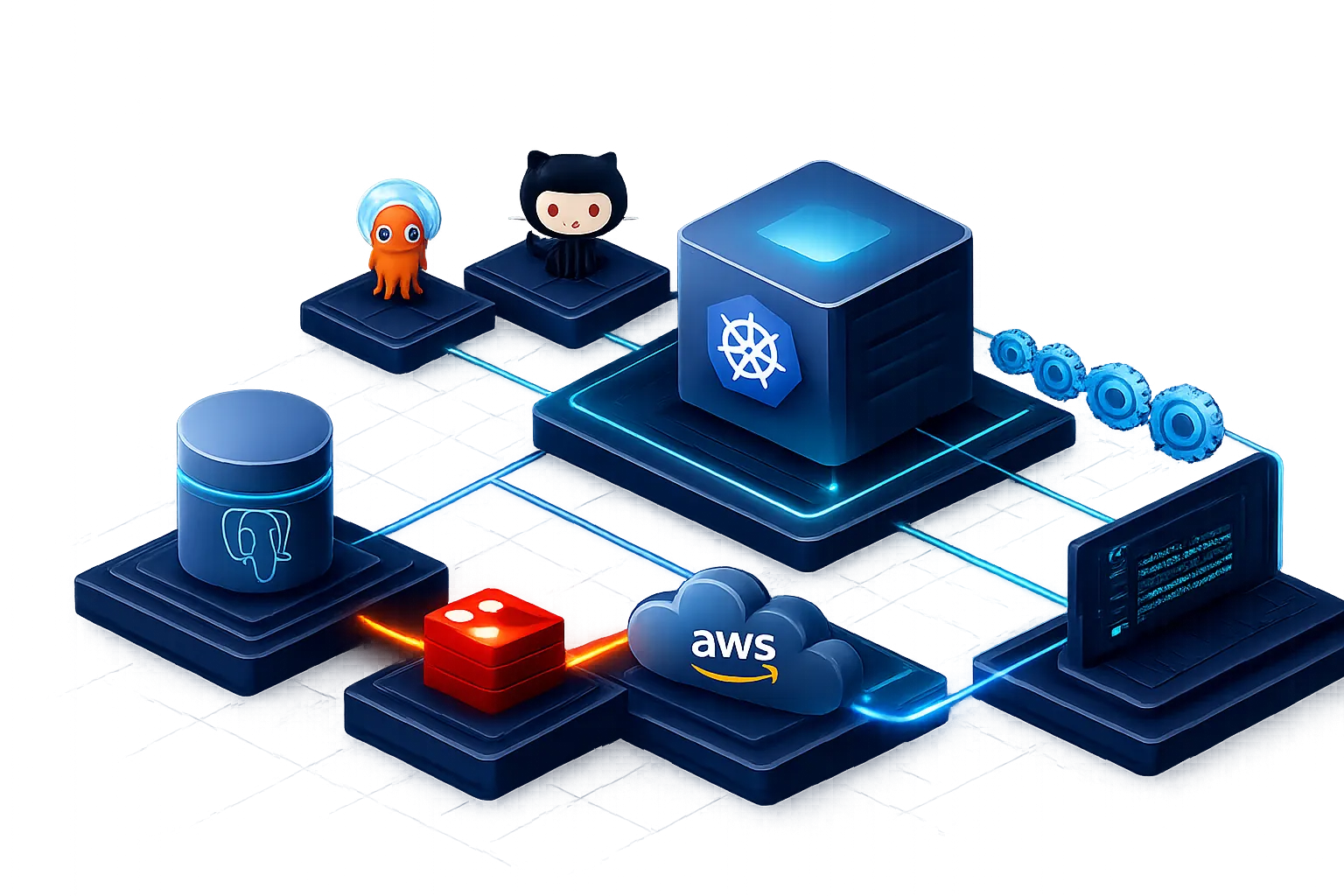
CI/CD, GitOps, Infrastructure as Code, and automation to ship faster and safer.
PostgreSQL, CloudNativePG, back-ups, failover, and performance tuning.
Kubernetes, HAProxy, monitoring, scalability, and cloud native architectures.
Go services, APIs, clean architecture, and reliable backend systems.
Inventory
The technologies and tools I use to build, deploy, and maintain modern applications and infrastructure.
Chronology
A timeline of my professional journey and key milestones.
DevOps Engineer with experience in cloud infrastructure, CI/CD, deployments, monitoring, and backend development. I work across infrastructure and application layers, with hands-on experience in AWS, Docker, Kubernetes, GitHub Actions, PostgreSQL, Go, and Node.js.
Portfolio
Some of the platforms and systems I've built, deployed, and currently maintain.
Self-service Terraform + Ansible bootstrap that provisions an EC2, installs Docker and GitHub Actions runners, and renders a Docker Compose stack with a project-specific directory layout and .env.
RESTful API backend for the Growli parenting and education platform: auth, content, subscriptions, real-time notifications, and media — built on Echo, PostgreSQL, Redis, and AWS S3.
Multi-tenant prayer platform backend shipping two binaries from one codebase: an Echo HTTP API and a NATS JetStream worker for email, media transcoding, push notifications, and chat persistence.
Deployment pipeline
Explore two production delivery paths: Kubernetes GitOps reconciliation and direct server deployment.
An immutable image moves through registry automation, Git write-back, Helm rendering, Argo CD reconciliation, and a Kubernetes rolling update.
Stage 01 / 09 · Source control
A reviewed application change is merged into the production branch, creating the immutable revision used throughout delivery.
Stage 02 / 09 · CI orchestration
GitHub Actions receives the push event, checks out the exact revision, and prepares an isolated Buildx runner.
Stage 03 / 09 · Registry authentication
A protected GitHub Actions secret creates a short-lived registry session without exposing credentials in source or logs.
Stage 04 / 09 · Container build
Buildx creates the production image and tags it with both the source branch and the short commit hash for traceability.
Stage 05 / 09 · Image publishing
The immutable branch-and-revision image is uploaded to the private registry and becomes available to deployment automation.
Stage 06 / 09 · Image automation
Argo CD Image Updater scans registry metadata, filters eligible main-branch tags, and selects the newest allowed build.
Stage 07 / 09 · Git write-back
Image Updater writes the selected image tag back to the GitOps source of truth, where application manifests, Helm charts, and environment values live.
Stage 08 / 09 · Desired-state reconciliation
Argo CD detects the Git revision, renders the shared Helm chart with its production values, and automatically syncs the desired state.
Stage 09 / 09 · Kubernetes deployment
The Deployment replaces pods gradually, pulls the immutable image, injects runtime configuration, and waits for readiness before completion.
Kubernetes GitOps. Stage 1 of 9: Developer commits to main
A direct-host release packages an image, connects securely to production, and executes the remote deployment workflow.
Stage 01 / 09 · Source control
A developer pushes the latest application changes to the main branch, starting the production deployment workflow.
Stage 02 / 09 · CI/CD orchestration
GitHub detects the push and starts the production deployment job on a managed Ubuntu runner.
Stage 03 / 09 · Secret management
GitHub Actions Secrets provides the deployment credentials used to authenticate to HashiCorp Vault, which supplies the protected application configuration.
Stage 04 / 09 · Container build
The runner builds a production-ready OCI image from the repository Dockerfile and generated environment configuration.
Stage 05 / 09 · Secure connection
The image is exported as an archive while the workflow verifies and opens an encrypted SSH connection to production.
Stage 06 / 09 · Remote Docker
A remote Docker context routes subsequent commands through SSH to the Docker daemon running on the production host.
Stage 07 / 09 · Image delivery
The previous runtime is removed safely before the newly built image is loaded into the remote Docker daemon.
Stage 08 / 09 · Application deployment
The workflow invokes the deployment script on the production host to start the application with its production configuration.
Stage 09 / 09 · Production runtime
The new application revision is healthy inside its Docker container and the production deployment has completed.
Server Deployment. Stage 1 of 9: git push origin main
Contact
Open to conversations about platform engineering, backend systems, and infrastructure reliability.
sulav.adk.7@gmail.com
linkedin.com/in/sulav-adhikari
GitHub
github.com/sulav-adhikari
Location
Kathmandu, Nepal